
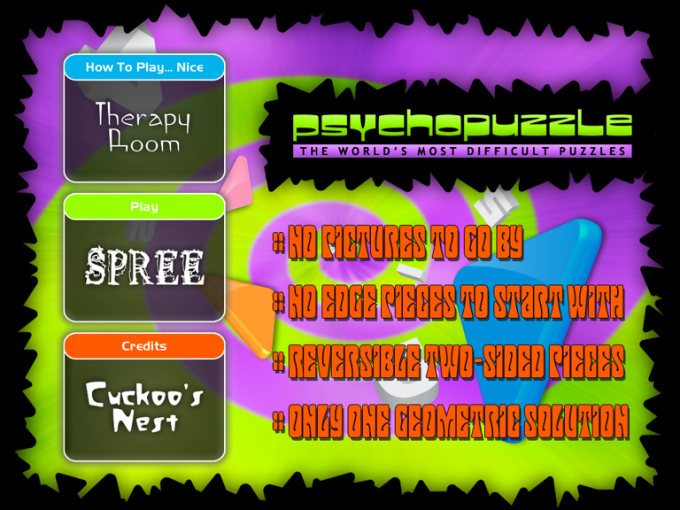
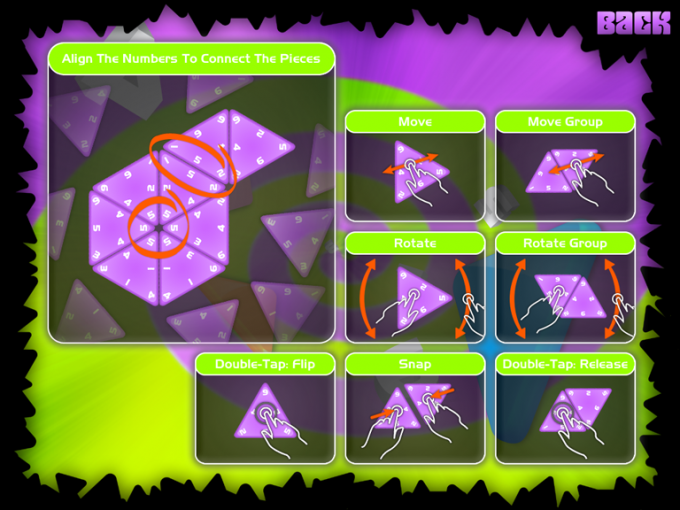
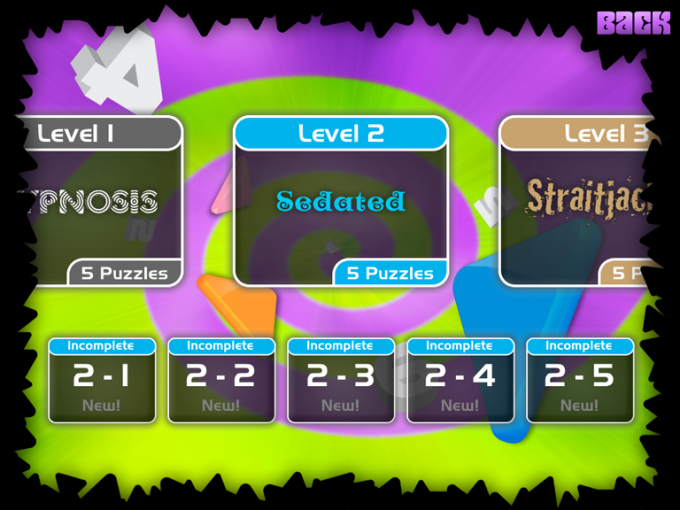
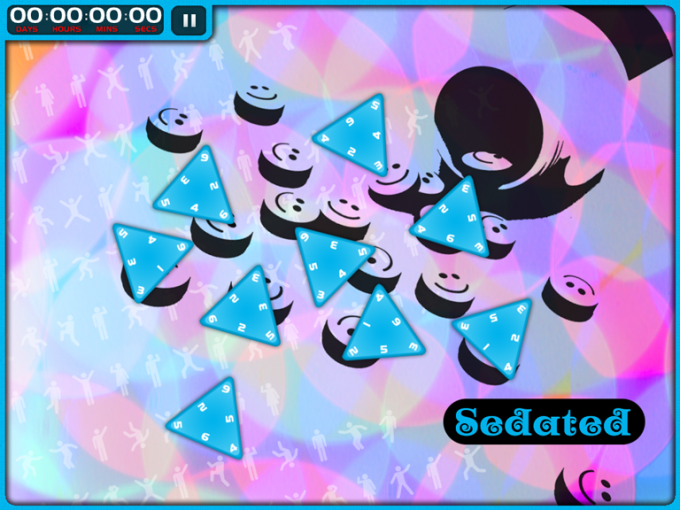
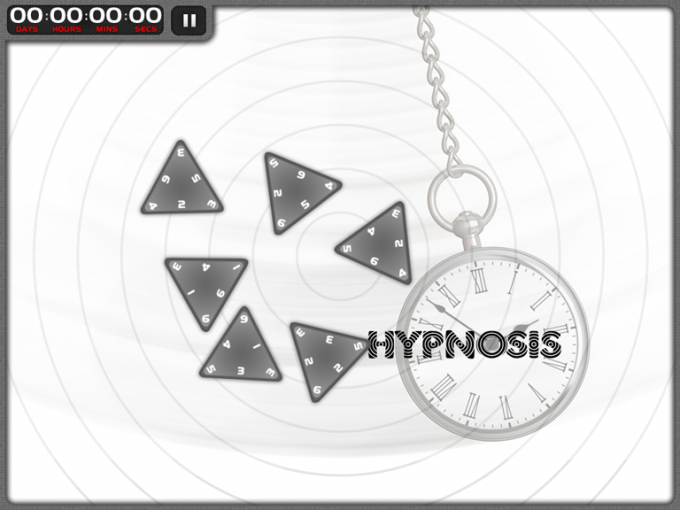
A fun, challenging, and mentally stressful project to work on, PsychoPuzzle fueled my passion for gaming while adhering to the client’s psychedelic artistic direction. All puzzle pieces were created from scratch in Illustrator, ported to Photoshop for some fine-tuning and batch exported in several different colors to create variety throughout the different puzzle boards. All menus, game boards, and help screens were a Photoshop file re-using the main design assets to keep a consistent style. The end result is an iPad puzzle game that even with all the answers at my disposal is still difficult to solve. PsychoPuzzle.com describes it as:
PsychoPuzzle is a three dimensional, double-sided, geometric puzzle that uses numbers as the connection device because it takes longer for the brain to process their shapes compared to colors or squiggled lines. All of the pieces are identically sized/shaped triangles with a single digit at each tip and centered along each length, giving each length a number sequence of 3 digits and each piece a total of six digits per side. The number sequences are repeated on multiple pieces meaning one piece could potentially align with several other pieces. To further frustrate game players the number sequences on the facing side of the pieces are mirrored on the reverse side.
The object of PsychoPuzzle is to align all of the pieces in the proper order using the number sequences as a guide. If a puzzle piece has a number sequence of 1-2-3 along one length, the adjacent piece along that length would match 1 to 1, 2 to 2, and 3 to 3. There is only one correct solution to the puzzle.
PsychoPuzzle was designed to be the most difficult tabletop-like puzzle ever created. To accomplish that goal the game takes away as many of the hints to solving a traditional style puzzle as possible while retaining just enough information, the connection device, to constitute a challenge. So, there are no pictures of the completed puzzles provided. There is no image on the pieces that would aide in sorting. There are no obvious edge pieces from which to start building. There is no game board to map out the final shape of the completed puzzle.
The net result is a blank area, with a handful of puzzle pieces that have multiple possible matches, with no clue as to where to begin or what the end will look like… hence the name PsychoPuzzle.
